Bail Reform Part Two
The right's 'Political Pile-Driver' and 'Flooding the Zone with Shit'

In my last post on this subject I mentioned the way politicians, reporters, and, police have been misusing statistics about police deaths in order to create a panic among voters. (Truth be told, after I was finished working on that article, the CBC published a story that pretty much agrees with mine. Having said that, I see it as a unicorn—mainstream journalism almost never attempts to truth-check statistical assertions.)
I’ve been making a fuss because I see Pierre Poilievre’s discussion of the topic as an example of a disturbing trend in politics: the partisan politics pile-driver.

By ‘pile-driver’ I mean the unrelenting repetition of half-truths and bald-faced lies that get pounded into the public’s consciousness until they start to believe them. This has become a very important tactic that a certain ilk of politician uses to gain publicity and supporters, and, fund-raise.
Here are some examples of very successful recent pile-drivers:
the assertion by Donald Trump that Barack Obama wasn’t born in the USA, hence he shouldn’t be president
Trump saying that Joe Biden didn’t actually win the 2020 election, but instead ‘stole’ it
Conservative complaints that hordes of ‘illegal immigrants’ were storming across the boarders into Canada, where they ‘jump the queue’ ahead legal immigrants (Canada was just abiding by UN regulations concerning refugees)
anti-vaxx leaders complaining that vaccine mandates and pandemic lock-downs were in some sense unprecedented infringements of traditional civic liberties
police union leadership implying that being a police officer is tremendously dangerous, so they should be allowed maximum freedom in how they do their job
gun ‘rights’ groups assertion that banning modern, military-style assault and battle rifles is going to create undue hardships for hunters and recreational shooters
Think about the partisan politics pile-driver while watching this clip from that bastion of journalistic integrity, The Toronto Sun:
I’m going to do what’s called in philosophy a ‘deconstruction’ and discuss some very contentious statements Poilievre makes in it concerning the criminal justice system.
Were 40 offenders arrested and released on bail 6,000 times in one year?
This is an interesting statement, one that’s almost impossible to refute due to the inconsistent, secretive way that the criminal justice system collects and distributes raw data. But I did find an article by Michael Spratt in Canadian Lawyer Magazine made some interesting statements on the subject.
Poilievre’s claim, made in the context of a press conference about violent crime, that 40 people were arrested 6,000 times last year in Vancouver, and I am choosing my words carefully here, is bullshit.
If true, this would mean that, on average, these people were arrested 150 times in one year, almost once every other day. I have never seen anything like this in criminal court over two decades. No one has.
Even 150 charges per year, assuming multiple charges per arrest, is unheard of.
Spratt bends over backwards to give Poilievre the benefit of the doubt. To that end, he suggests that he is misremembering another figure.
But perhaps Poilievre was misrepresenting the data and meant 6,000 interactions with police, which is very different from arrests and does nothing to support Poilievre’s contention that there is a “catch-and-release” problem driving violent crime (which decreased in Vancouver anyway).
If the numbers are accurate, I suspect “negative” interactions mean minor property offences, police harassment, by-law tickets, and other non-violent and non-criminal offences.
Another suggestion he offers comes from a totally different jurisdiction.
The New York Times published an article based on NYPD self-reporting that 327 people were arrested 6,000 times for shoplifting offences. This rate is an order of magnitude lower than the numbers Poilievre was throwing around.
The above link is to a Twitter feed discussing an article published on April 15, 2023. What’s interesting about the original article are two very specific numbers that get quoted:
Nearly a third of all shoplifting arrests in New York City last year involved just 327 people, the police said. Collectively, they were arrested and rearrested more than 6,000 times, [my emphasis] Police Commissioner Keechant Sewell said. Some engage in shoplifting as a trade, while others are driven by addiction or mental illness; the police did not identify the 327 people in the analysis.
and
Last year, 41 people were indicted [my emphasis] in New York City in connection with a theft ring that state prosecutors said shoplifted millions of dollars worth of beauty products and luxury goods that were sold online.
Reading through this article, there is also a reference to a push by some politicians in New York State to toughen bail laws. When I followed a hyper-text link, I found a longer discussion about bail and violent crime. Here’s a relevant quote:
A key change to the bail laws that Mr. Adams has embraced concerns a proposal many judges support that would give them discretion to consider a defendant’s “dangerousness” in deciding whether to set bail.
Proponents point to the fact that New York is the only state in the country that does not give judges this authority. But critics point out that current bail laws do allow judges to set bail for violent crimes and for certain repeat offenders.
The prohibition on considering dangerousness predates the changes to bail laws in 2019. Bail defenders worry that including such a provision could fundamentally undercut the intention of the changes and reintroduce racial disparities into the process, potentially leading judges to hold people of color without bail at higher rates than white defendants.
“It’s really hard to come to an objective measure of dangerousness that is not burdened on some level by racial bias,” said Ames Grawert, a senior counsel with the Brennan Center for Justice.
The crux of the debate centers on whether the changes to the law have led to a spike in crimes committed after people were arrested and then released.
Lest readers take issue with this idea that it is hard to judge a defendant’s ‘dangerousness’ without bringing in racial bias, I’d like to point to the very common way some sectors of the population confuse the descriptors ‘obviously poor’ and ‘has psychological issues’ with ‘DANGEROUS’. (That’s why so many people are afraid to visit downtown Guelph—which is one of the safest cities in one of the safest countries in the world.)
The point I’m trying to get at is that there’s no plausible way that the numbers Poilievre quote actually came from courts in British Columbia. The best hypothesis Spratt can come up with is that these numbers are the garbled result of the game of ‘telephone’ we know as ‘social media’.

The reason why the message in a game of telephone changes from one link of the chain to another is because human beings get distracted, suffer from confirmation bias, confabulate, and, simply mis-remember what they read or hear. (Which is why it’s kinda important that we double-check any startling ‘factoid’ we come across—and why I stick all those hyper-text links in the body of my posts.)
Is it serious to suggest that ‘catch and release’ is related to a failure of support services?
Poilievre seems taken aback by the suggestion that what he’s calling ‘catch and release’ could be evidence of a failed social safety net. But when I made the effort to read some of the literature that came out in previous debates about bail, this relationship seemed plain as a pikestaff.
Looking at a Government of Canada report prepared in 2018 by Kyle Coady, I found the following list of problems in the old bail system that specifically relate to the failure of support services, these include:
The over-use of sureties for bail. A ‘surety’ is someone who will take on a significant financial obligation in order to ensure the accused shows up on time for hearings, abides by the rules of his release, etc. Obviously, poor or destitute people are going to have an extremely hard time finding a surety.
The criminal justice system sometimes places the onus on the accused to tell the court why they should be allowed bail. This makes it especially hard for people with mental illness and who lack legal counsel to avoid incarceration. (In 2019 the Ford government stopped funding Legal Aid for bail hearings. They also cut extra support for Legal Aid regarding people with mental illness and aboriginal defendents—who often require more work from a lawyer to prepare a case.)
Conditions of bail are often overly stringent and almost guaranteed to be broken. For example people who cause problems while drunk or while trying to get enough money for a heroin fix will get into trouble with the law. Making a condition of bail that these people abstain from alcohol or drugs—without offering some sort of mechanism for dealing with their addiction (like a bed in a detox centre) is a completely unrealistic stipulation that leads to rearrest for “failure to comply” with the conditions of bail.
Aboriginal people, in particular, have such a hard time getting bail that there seems to be a real problem with innocent people just pleading guilty in order to get the nonsense over and done with.
Overall, Coady says “court workers argue that a cultural shift towards risk aversion has resulted in a bail system that is overly punitive”.
All of these problems could be at least made less horrible if there was more of an infrastructure aimed at helping people—who are often suffering from any number of emotional, situational, or, psychiatric problems—navigate an alien and often unforgiving system. This could include government money being spent on:
detox centres where addicts could actually get help when arrested instead of forcing them to wait weeks for treatment
lessening reliance on sureties to acquire bail and finding some sort of alternative for people who don’t know anyone with sufficient financial means to be a surety
funding more legal help for people who cannot afford a lawyer for their bail hearing
funding programs to make the criminal justice more suited for the special cultural issues faced by the aboriginal peoples of Canada
training of police, judges, and, crown attorneys to realize that putting too many people in jail also has financial, emotional, and, social costs that must be balanced against any personal fear of being ‘the one who let a suspect out who later killed someone’
Are there repeat violent offenders who are committing 60 or 70 offenses being ‘caught and released’?
This is a difficult issue to respond to, because there simply doesn’t seem to be any available data being collected or distributed to the public. I spent hours and hours over several days trying to dig up recent info (or any, to be honest) that would support one side or the other. What I found were statements by criminal lawyers saying that this is a totally bogus statement based on their experience. They said that violent offenders and people found to be in possession of illegal fire arms generally find it extremely hard to get bail. On the opposite side, I have seen the odd anecdotal news story about some individual being out on bail and then committing a violent crime.
The problem with news stories is that journalists are not encouraged to tell the whole truth—instead, they are expected to tell an interesting story in a timely fashion. That means they cannot include all the ‘boring details’ which would often make the story more nuanced, and less exciting to readers. Moreover, they are almost always under a deadline, which means that they usually have to write an initial story within only several hours of an event and maybe a follow-up within a couple days. That means—almost by design—what the general public reads about an incident is usually incomplete and often misleading.
At this point I’m in the situation of trying to prove a negative with a limited data set—which is a fundamentally impossible task.
Here’s the takeaway, though. Where does Pierre Poilievre’s sense of certainty about this issue come from? In my humble opinion, he’s at best incapable of understanding the difference between anecdote and statistical trend—at worst, he doesn’t care as long as something sounds ‘truthy’.
“Truthiness” is the belief or assertion that a particular statement is true based on the intuition or perceptions of some individual or individuals, without regard to evidence, logic, intellectual examination, or facts. Truthiness can range from ignorant assertions of falsehoods to deliberate duplicity or propaganda intended to sway opinions.
(Wikipedia)
What sort of crimes do people commit while on bail?
Poilievre is tremendously concerned about people who break the law while out on bail, but I think there’s one point that we need to remember when we hear someone quote statistics about this. One of the most common things people get charged with is
”failure to comply with the terms of bail”. Here’s a 2015 Statistics Canada chart.
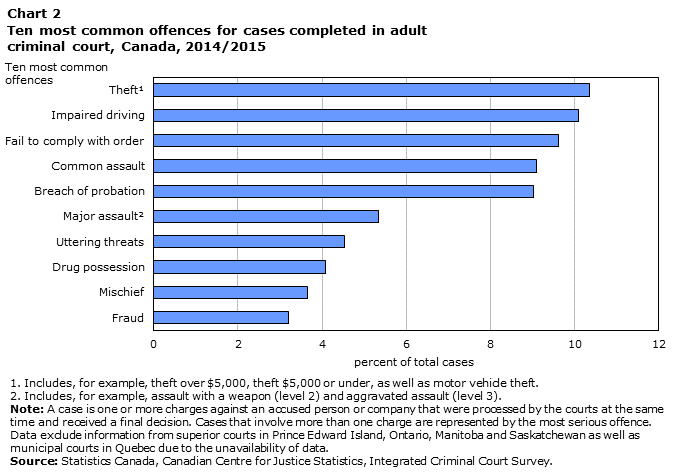
See the third category from the top? That’s ‘Fail to comply with order’, and that accounts for 9.6% of all the criminal charges leveled against all people in the sample. And that includes:
drug addicts and alcoholics who have been told to stop taking drugs or drinking
thieves who steal to survive being told to no longer steal
people who’s entire social network includes people with criminal records being told to not see any known criminals
people with severe emotional or psychiatric issues being told to not do whatever got them in the eye of the police in the first place (I see categories labelled ‘mischief’ and ‘uttering threats’—how often do people with mental illness commit such acts?)
If it is true that people out on bail do all sorts of things, I find it easier to believe that the overwhelming majority of the issues fit into the the category of “failure to comply” rather than the sort of rampant violence that Pierre Poilievre suggests is the case.
When people are behind bars, are they really unable to ‘commit crimes’?
Readers might be excused to see this as a tautology. But it misses a lot of important points.
First of all, crime happens in prisons all the time. Prisoners can and do commit crimes against each other. Guards commit crimes against prisoners too.
Beyond that, many prisoners are actually eventually exonerated by the criminal justice system. According to a 2015 Statistics Canada table, 37% of people charged with crimes didn’t end up-being convicted, and of those 21% had the charges withdrawn (lack of evidence?) and 4% were acquitted. (Let’s not forget that at least some of the people who pled guilty were innocent but falsely admitted guilt out of fear of losing a trial and getting a harsher sentence—or to just get the whole court nightmare over ASAP, as Kyle Coady states in the report I cited above.) Moreover, when someone ends up in jail their life gets totally upended: they lose their jobs, pile up debts, relationships and reputations suffer, etc. This all sucks if you are guilty—imagine what it’s like when you’re actually innocent.
Moreover, keeping people in jail isn’t cheap. I found a report by the Parliamentary Budget Officer for 2017 that says that it costs about $130/day to house a prisoner in the cheapest level of security at a federal facility. I’m going to assume that if we are going to incarcerate a prisoner pretrial that the costs would be similar. It strikes me that the bail system is saving the tax-payer a lot of money. Moreover, if we were willing to pay $130/day/accused person for drug treatment, providing shelter, accessing psychiatric, and, financing Legal Aid—we’d be seeing a lot fewer problems.
It just seems obvious to me that there is an opportunity cost associated with not providing timely, accessible, appropriate bail to people accused of committing crimes. And the reverse is true—if Canada were to bring in the draconian policies that Poilievre believes are necessary, it would create a lot of unnecessary personal misery, chaos within the legal system, and, suck huge amounts of money out of programs that would have a much better impact on people’s lives. (Actually, I can’t see how the Supreme Court would not strike down Poilievre’s policy suggestions if passed into law.)
Flooding the Zone with Shit
This isn’t the first article I’ve done on Pierre Poilievre confabulating on YouTube videos and at media events. I did one before about his response to proposed Liberal gun legislation, and I keep getting new ones on other subjects recommended to me by the YouTube algorithm. (Remember, social media recommendations are generated by fear and anger—and Poilivre’s sermons are designed to stoke both.)
Why exactly is the Conservative party putting out these sorts of messages?
I think the best description of what’s happening comes from a Vox Op Ed by Sean Illing.
The issue for many people isn’t exactly a denial of truth as such. It’s more a growing weariness over the process of finding the truth at all. And that weariness leads more and more people to abandon the idea that the truth is knowable.
I call this “manufactured” because it’s the consequence of a deliberate strategy. It was distilled almost perfectly by Steve Bannon, the former head of Breitbart News and chief strategist for Donald Trump. “The Democrats don’t matter,” Bannon reportedly said in 2018. “The real opposition is the media. And the way to deal with them is to flood the zone with shit.”
I sometimes hear people say that my articles are too long, that they go into too much detail. That’s because it is easy to make short, snappy articles that appeal to prejudice and cliche, but it takes a lot longer to explain why the prejudices and cliches are wrong. It’s simply the difference between the truth and a lie. That’s where the saying “a lie is halfway around the world before the truth gets its boots on” comes from.
Pierre Poilievre and the Conservative Party of Canada have declared war not primarily on the Liberals, but more importantly on the idea of “truth”. They want to instead make ‘truthiness’ (ie: a plausible-sounding appeal to pre-existing prejudice) the standard of political debate. To that end, their public outreach apparatus is increasingly being devoted to flooding Canada with shit. That’s what the pile-driver I mentioned in the beginning is ultimately all about—pounding to pieces Canadian’s concept of truth versus nonsense in public policy.