Bail Reform, Part One
Unprecedented police killings? or statistical ignorance/malfeasance?

The Conservatives are constantly trying to scare the public into voting for them, which means that the Kabuki theater in Ottawa is now moving from “the Trudeau government is using the Chinese to persecute Conservatives” to “the Trudeau government is too lenient on criminals”.

This uproar has been caused by a supposed uptick in police killings. But once again, I see collusion between vested interests instead of reality. This time it isn’t just the Conservatives and the media—we have some police leaders involved too.
Here’s a quote from the CBC where a police official comments about the latest round of police being murdered while on duty:
"This is unprecedented in Canada," said Mark Baxter, president of the Police Association of Ontario, which represents 28,000 sworn members from 45 police associations across the province.
"I've been in policing for 18 years, but certainly during my time I've never seen anything like this," said Baxter.
"It really has shaken our profession to the core."
Ho hum. I guess I need to write something about this.
First, let’s see if these latest killings really are ‘unprecedented’. Here are a couple graphs of police (ie: not corrections officers, conservation officers, U.N. peacekeepers, etc) being murdered (ie: not just killed on the job—no traffic accidents, drownings, etc). The first one is from a study I found on the Statistics Canada website titled Police Officers Murdered in the Line of Duty, 1961 to 2009 by Sara Dunn. The second is a bar graph I created myself using information from the Police and Peace Officers’ Memorial Ribbon Society.
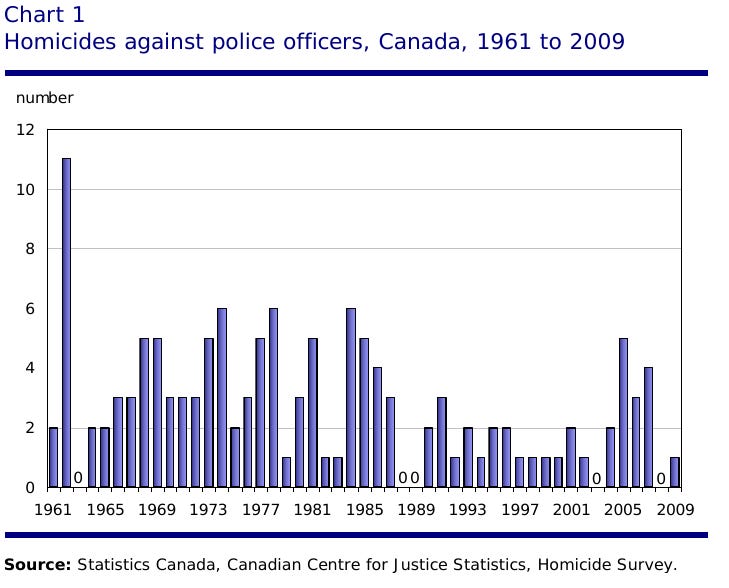
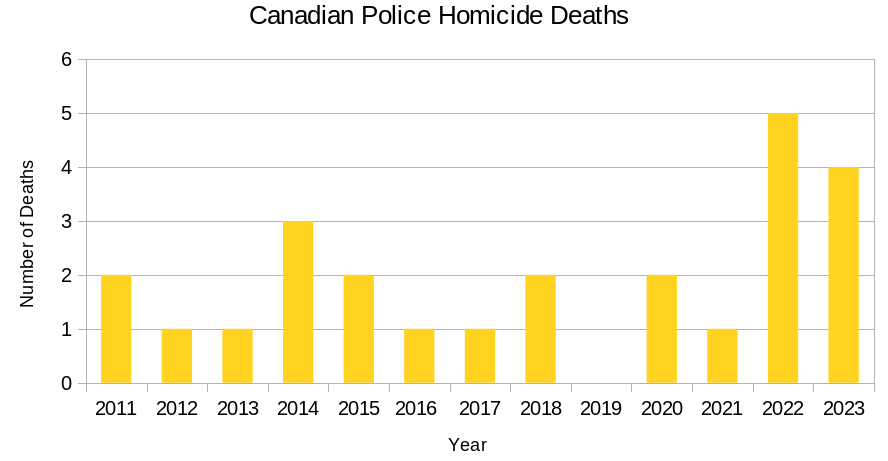
Look at those two graphs carefully, and pay attention to the number of deaths. In actual fact, if you go back to 1961 you will see a year where 11 police officers were murdered, three years where 6 were killed, and, eight (including 2022) where five were killed. Indeed, one of those years seems to be roughly when Mark Baxter became a police officer. So, let’s just say that his statements were ‘wrong’ and this number of deaths isn’t really ‘unprecedented’.
Next let’s look at another graph. It shows the growth in the Canadian population since 1961. (It comes from the website MacroTrends.)
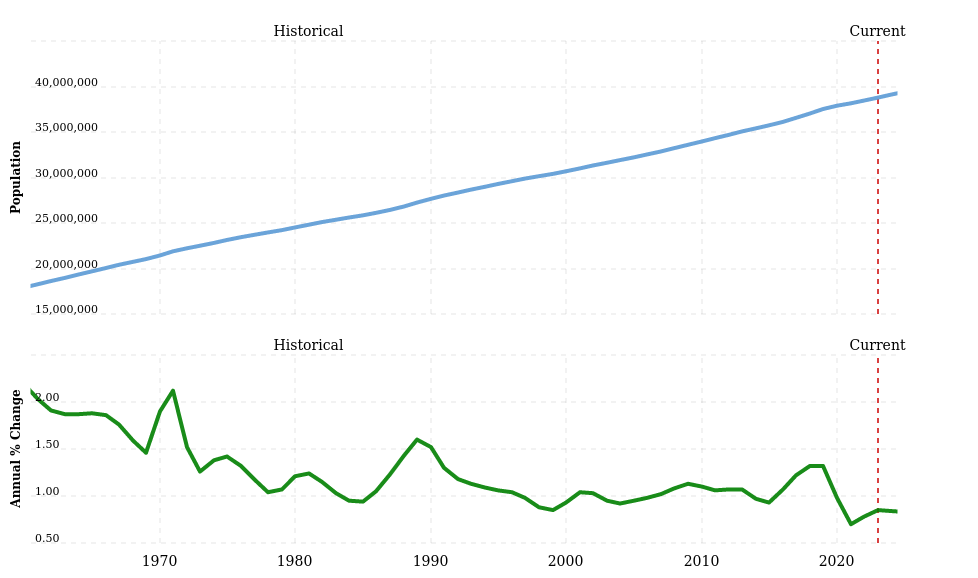
As you can see, our population in 1961 was about 17.5 million and now it’s about 38, or, more than double. That would mean that if we expressed those numbers with relationship to the present population size, those 11 murdered officers in 1961 would be 22 in 2023, or, with regard to the population in 1961, those 5 ones in 2022 would be 2 (we’ve more than doubled).
If I haven’t beaten this dead horse enough, let’s look at yet another way in which this story shouldn’t be taken too seriously.
In statistics it’s important to account for what’s called either ‘noise’ or ‘churn’. This is the case when you are measuring rare and random occurrences (eg: police murders) in huge populations (eg: Canada). That’s because we are measuring a ‘stocastic’ phenomenon (ie: one where each incident is in some sense random, but added together you can still see a trend).
To understand this point, take a look at these three images I took from the Ecology Center.
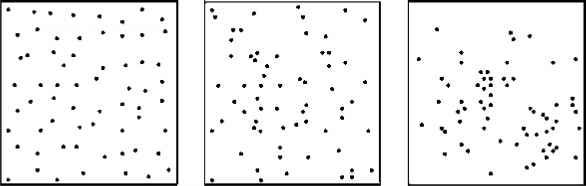
Now answer this question—which of these images shows randomly distributed points?
It’s the middle one.
The on on the left is evenly distributed, not randomly. If you were under the assumption that those two things are the same, ask yourself what you are doing when you make an effort to spread seed on a lawn evenly? An evenly distributed population has a mechanism that is trying have the same distance between each individual, which is different from random distribution.
The one on the right shows evidence of clumping. That’s when there is some mechanism that is trying to place objects next to each other. The stars in our sky are neither randomly nor evenly distributed—they are clumped together by gravity into star clusters, galaxies, and, super-clusters of galaxies. That’s why we have this relatively bright patch in the night sky called the Milky Way. It’s the galaxy we inhabit which consists of billions of stars clumping together because of gravity.
The selection in the middle is the only group of objects that should be called ‘random’. People often have a hard time understanding the issue of random events being analyzed and shown to have a stocastic relationship, so I’m going to stick in a short video with Neil deGrasse Tyson where he explains the difference between churn and a statistical trend—without actually using the term ‘churn’.
He’s describing the relationship between the individual data points of weather (the dog) and the long-term trend we call climate (deGrasse Tyson). In the case of the graphs I’ve posted above, the individual killings of officers in one particular year are the data points (the dog), whereas the long term trend we see from 1961 to 2023 is the trend (deGrasse Tyson).
And if you look at the long-term trend from 1961 to 2023 there has been a significant long-term drop in the per year average of Canadian police officer homicides. This should be obvious from a casual look at the two graphs—even without trying to factor in the nation’s population change.
Another point that deserves mention is that while Mark Baxter says that he’s never seen anything like 2022 and 2023 in his 18 years, this isn’t exactly true. If you look at the first graph, you will see a spike (the dog was chasing something and yanked on deGrasse Tyson’s leash) around 2005 (ie: when Baxter supposedly joined a police force) where in three years there were 5, 3, and, 4 officers murdered on the job.
And these two spikes in the data don’t disprove the general trend. That’s because a graph of police deaths by year that didn’t show the occasional spike would strike me as being suspicious—because it just stands to reason that these things would exist if no one was ‘fudging the numbers’. These periodic instances that are above or below average are what statisticians call “churn”.
There is a problem in statistical analysis known as “cherry picking”. That’s when a person—usually with a preconceived hypothesis—looks at a collection of data and just chooses one particular set of points to build an argument on. In the case of Mr. Baxter, he’s just looking at last year and this one, comparing that with the last ten years or so, and assuming/asserting that something truly bizarre is happening. That’s the cherry picking fallacy, and that’s why I went through the trouble of finding past numbers from the two websites I consulted. That’s how you guard against cherry picking.
To be honest, I’m appalled that the head of an important police association and the CBC don’t seem to have done the same thing. In fact, however, if you do a close read of the CBC article I quoted above, something strange seems to be happening.
Mark Baxter starts off saying “this is unprecedented in Canada”. Then the author of the article, Patrick Swadden, writes “In Ontario between 1961 and 2009, data from Statistics Canada show 44 homicides against police officers, a rate of less than one per year.” This is cherry picking, because Swadden starts with a quote about Canada—and includes the murder of an officer in BC in the list he mentions—but cites the lowest number he could find for killings in the past. If he’d quoted the number for the whole country consistently, he’d have said ‘In Canada between 1961 and 2009, data from Statistics Canada show 152 homicides against police officers, a rate of a little over 3 per year’—something that would have sounded a lot less ominous. Switching the sample you are describing to find the most jarring sounding numbers is a classic case of cherry picking and it’s exactly the sort of thing that professional journalists sometimes do to ‘sex up’ stories.
&&&&
At this point I think it’s important to make a bit of an editorial comment.
Why didn’t the journalist at the CBC come up with the information I’ve pointed out above? And why did the President of the Police Association Ontario not seem to understand these points either? Why is it up to an independent Substack writer making the princely sum of about $50/month to do all the work of parsing out the truth of an important public policy issue so a tiny number of loyal readers could see it? Why can’t the publicly-funded CBC do it? Or the guy who’s paid to develop policy and lobby for it on the behalf of Ontario’s police officers?
I believe there’s a systemic problem with the news industry in that people who consider themselves professional ‘sales reps’, ‘public relations officers’, or, ‘advocates’ for a particular industry or point of view have far too much influence on how stories are selected and packaged for public consumption.
In the case of the CBC story, I’d suggest that somewhere in the pipeline people in the newsroom decided that they had to make stories more “emotional” or “hard-hitting” to be able to compete with other news organizations. The result is less news based on the sort of factual analysis I try to do, and more that makes it look like the sky is falling.
Similarly, I suspect the Police Association of Ontario has hired public relations professionals who have told the leadership that if they want to get any attention they need to exaggerate and ‘spin’ stories to get the attention of both editorial staff and the public at large. If anyone raised the complaint to the effect of ‘but that’s not true’, I suspect the usual refrain of “everyone does it” or “if you don’t do it no one will ever pay any attention to what you say” came up.
Ultimately, it usually comes down to people’s personal financial interests trumping the idea that journalism should serve the public interest:
It Is Difficult to Get a Man to Understand Something When His Salary Depends Upon His Not Understanding It
Upton Sinclair
&&&&
Having said all of the above, there is another thing that readers should consider. We have no way of knowing this right now, but that blip of new killings could be an instance of clumping instead of churn. That’s because it is sometimes really hard to tell whether or not something is random or an instance of clumping. (In the visual examples I cited above, they were examples from a biological study—where the mechanism that led to a clumping diagnosis was identified.)
This alternative hypothesis would suggest that there might be some factor in society that is causing an increase in killings—beyond Poilievre’s idea that it’s caused by bail policies that are too lenient. For example, I can think of several possibilities just off the top of my head:
the increase in right-wing violence caused by the growth of neo-fascism in general
a growth in radicalism of all types because of the general increase in conspiracy thinking due to the pandemic lock down (what about those guys at the blockades? where did they go and what are they up to?)
the general rise in anxiety among people due to our housing crisis—being afraid of losing your home will presumably tip some people over the edge
an increase in people forced onto the streets and becoming enraged because of being repeatedly moved around by police officers without any real attempt at finding them housing
the fraying of the social fabric due to all of the above
The problem with identifying what might be behind this possible clumping behaviour is that we simply cannot tell whether we are seeing random distribution or clumping until we have a much larger data sample. That means more years of waiting for statistics before we leap to conclusions. And even if we are seeing clumping, we also have to find the mechanism—and that requires further work. Even if we have a real problem, it does no good to just pull some random idea out of the air and fixate on it as the solution.
That’s because when people suggest ‘reforms’ before they have the information to actually know what is going on, the proposed solutions often stay in place long after the issue has been dealt with by other means. (Does any reader remember how invading Iraq was going to end terrorism?) And bad policies can dramatically degrade the lives of both individuals and the nation-at-large. Right now the Conservative pile-driver is attempting to change the criminal justice’s bail system. I’m not convinced that what they are suggesting makes much sense and I’m afraid they could erode our liberties quite substantially.
But this is enough for people to digest right now, so I’ll leave that part of the story for a future article.