Why You Should Join Mastodon
Or, if We Must Have Social Media---People Should Take Control of it!


I’ve been trying on-and-off to get onto Mastodon for several years. Unfortunately, the first times I tried there weren’t any good user manuals or easily-used software interfaces that I could quickly find. Moreover, it didn’t look like the user base was large enough to be of much use for me. So I gave up and waited until it ‘jelled’. This changed last year after Elon Musk took over Twitter and announced that it was going to make a general transition towards free speech absolutism.
At that point it appears that the people who liked the fact that Twitter was even slightly moderated decided that they wanted to find something better. And a sizable fraction of them decided to move to Mastodon—which made the place better and eventually initiated in a positive feedback growth loop. Here’s a graph that plots the growth of Mastodon users against key incidents in the Musk/Twitter soap opera:
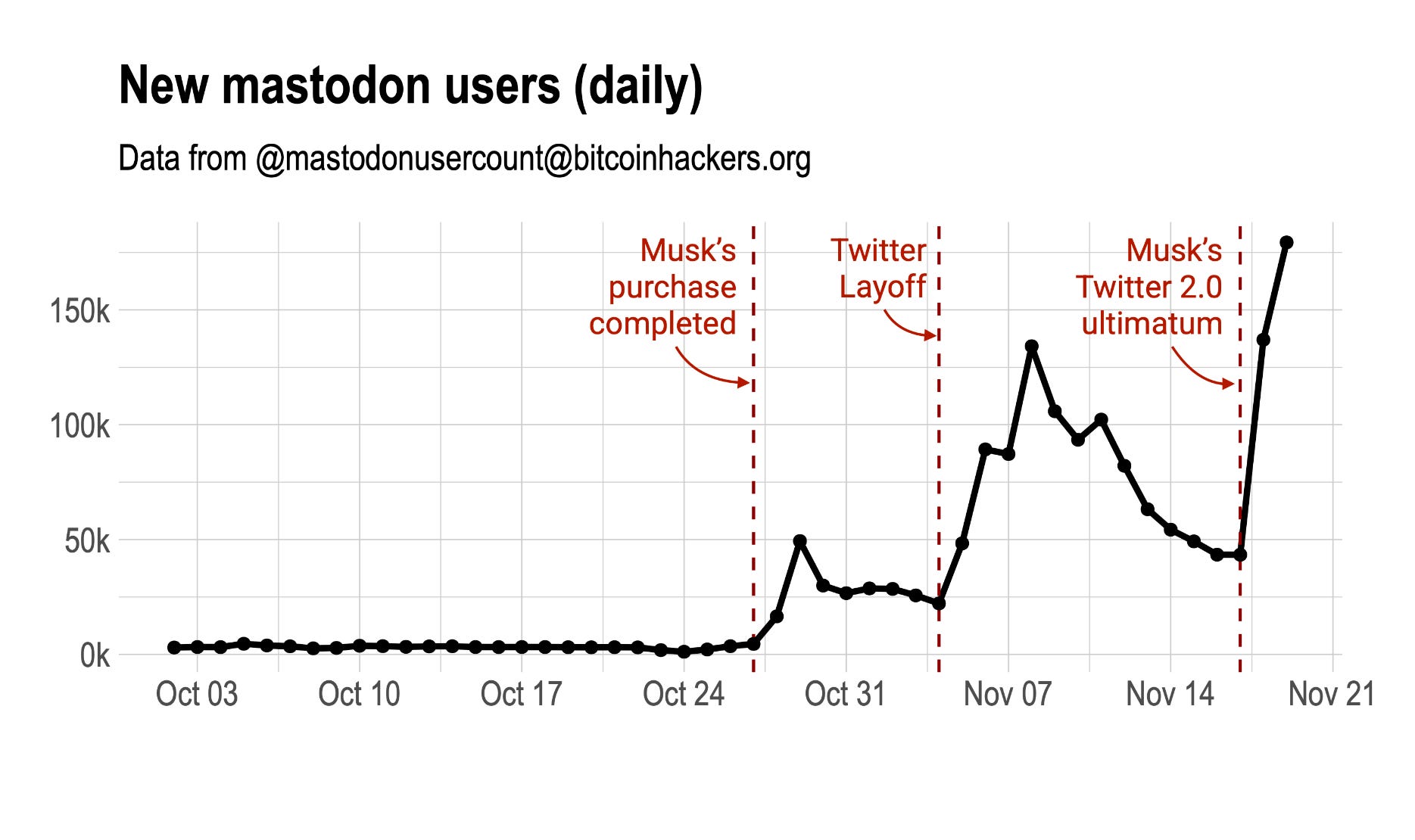
(I joined in mid-November.) As of writing, these are the latest user numbers I could find (both graphs from @mastodonusercount@bitcoinhackers.org):
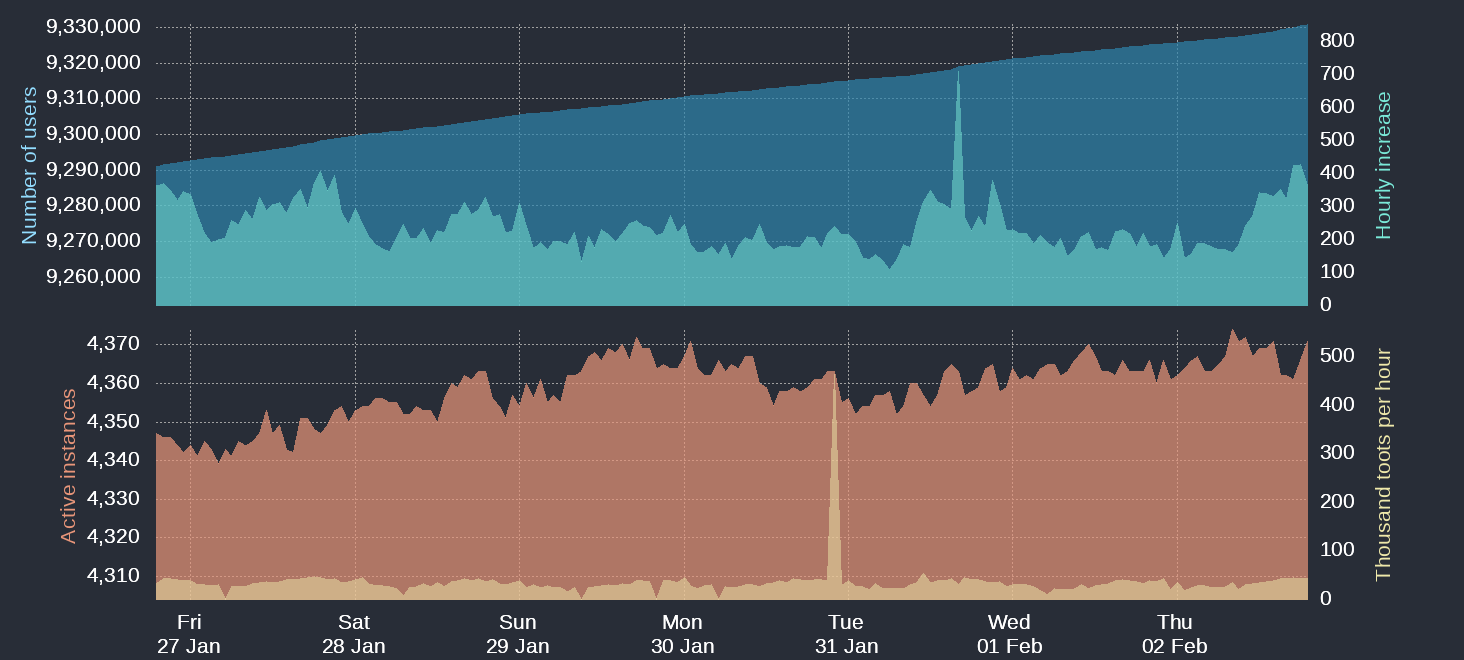
As you can see (pay attention to the colour coding in the graphs), as of Feb 02/2023, there are now over 9.3 million accounts, 4,370 server locations, and, something like 50,000 posts per hour. This is a massive increase.
Of course, Mastodon is still a ‘drop in the bucket’ compared to other social media systems. Take a look at the following graph of major Social Media platforms from Our World in Data:
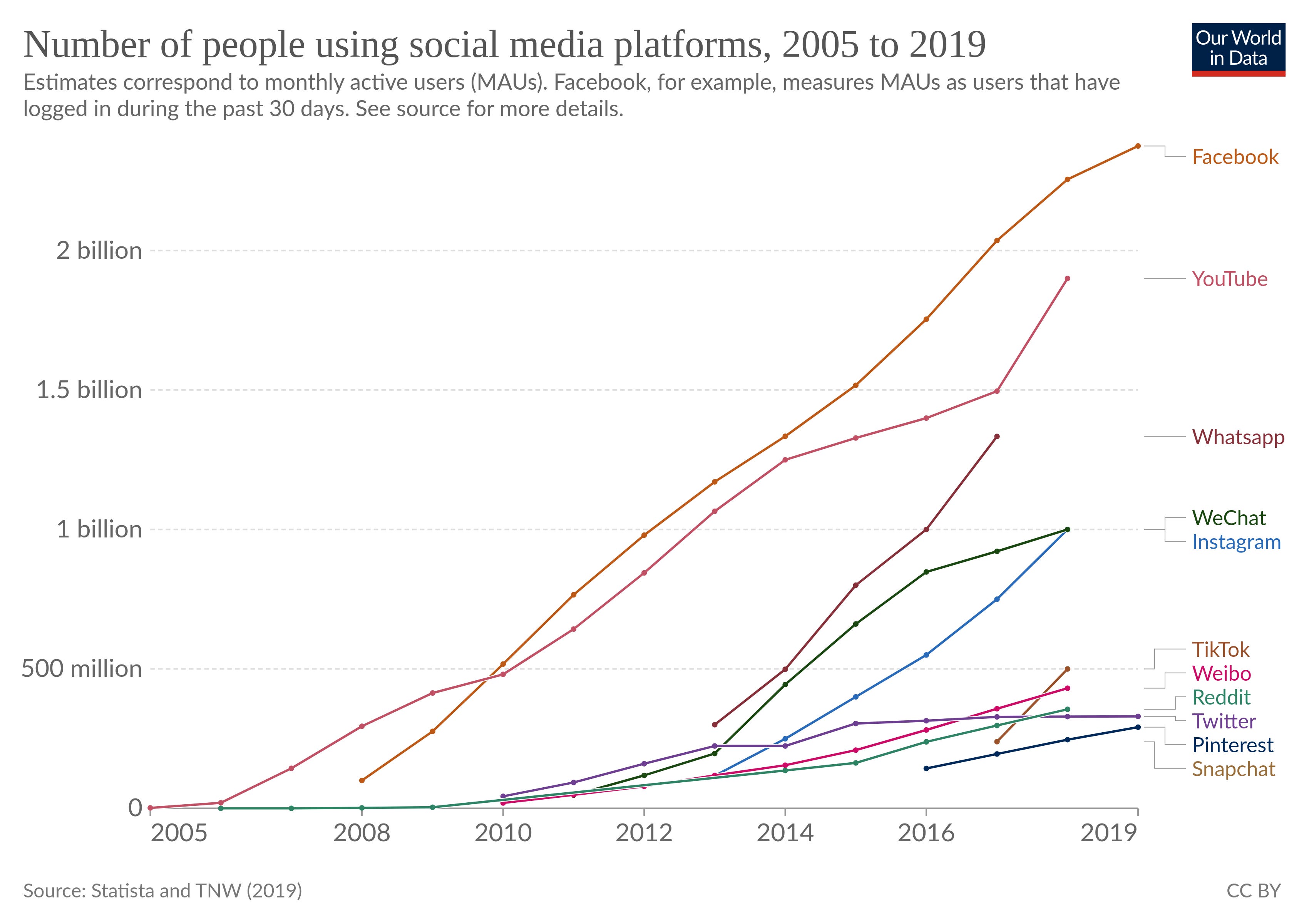
But having acknowledged how much bigger Facebook and YouTube are than Mastodon, this doesn’t mean that the new platform is too small to be of value to users or to exert an influence on society. And I would suggest that the rapid adoption of Mastodon—if nothing else—shows that there is an interest in alternatives to the existing social media business model.
So what exactly is Mastodon and how is it different from Twitter?
The first thing to understand is that Mastodon isn’t a social media company like Twitter or Facebook. Instead, it is simply the name of an open-source computer program. There isn’t a centralized business named ‘Mastodon’ that runs server farms and makes operating decisions in order to make money for shareholders. Instead, anyone who wants can simply download the Mastodon software for free, spin it up on a server, and, then use it to help a group of others communicate with similar groups of people all over the world.
These individual social media sites are called ‘instances’. What makes Mastodon a global system is the fact that there are a set of agree-upon protocols that come with the program that allows—if people want—to link together different instances into something called ‘the fediverse’. (The idea is that this is a ‘federation’ of individual instances linked together for common interest.)
This federation model is extremely important to the appeal of Mastodon. That’s because it bases the system on grass-roots co-operation instead of a Bond-villain style hierarchy. It can do this because the operating costs of the system are dramatically less than for a giant ‘engulf and devour’ style corporation.
Just to give you an idea of how much cheaper Mastodon is to run than something like FaceBook or Twitter, here’s a screenshot of the ‘open books’ page of the instance I use, Mindly.Social:
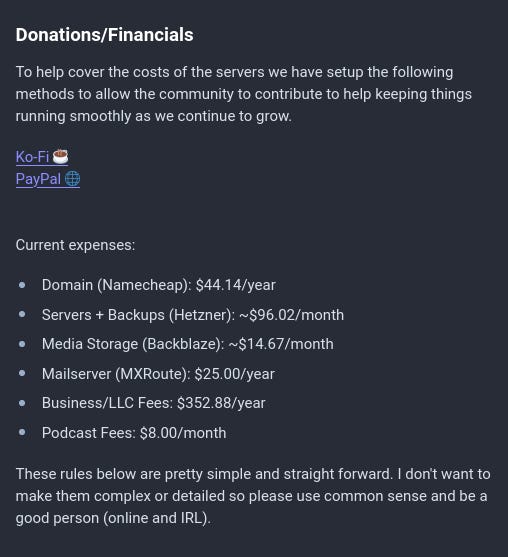
The latest info I could find says that this particular server has over 23,000 members. This makes it far from either the largest or smallest. But as you can see, it’s operational costs are a little under $550/year. And while there is a way to support the volunteers running these instances (I’ve sent a few bucks to Mindly.social myself), there really is no incentive or even sense in creating a small number of huge instances. Instead, the ideal situation would be for lots of small instances to be created in small communities (both geographic and interest-based) because they can link together like Lego blocks to create a bigger and better decentralized Fediverse.
The low cost of starting an instance means that many local institutions could easily set up their own for the equivalent of pocket change. For example, the Public Library could set up it’s own ‘Guelph book lovers’ instance. City Hall could create a ‘Guelph local government’ instance. The university, the downtown development district, the Guelph Arts Council, etc, could all get into the act. So could political parties, labour groups, churches, charities, businessess, and, of course, individuals.
This is an important issue because the specific instance you join has an impact on the sort of information you glean from it in the form of random posts. That is, when you look at your ‘local’ option, the posts you see are just from your local instance—the @Guelph Book Lovers or @Local Politics group, for example. This—at least initially—focuses the randomized posts you get on your local feed towards a specific interest.
You can access toots from other instances on the fediverse in other ways. There’s a ‘federated’ option on your web-browser interface which allows you to see every toot from all the instances federated with yours as they come up—but that is like drinking from a firehose so I rarely use it. The usual feed I see is titled ‘home’ and involves the toots from people I follow, and, the toots they choose to ‘boost’ (ie: repost) from the people they follow.
For example, there’s a woman on @newsie social I came across somehow and decided to follow because her personal description says she is interested in the use of social media to manipulate people. Yesterday she said that she’d just published a paper on the role of Russian government disinformation in last year’s Ottawa truck convoy/occupation fiasco. I looked at the link she presented with the post and found a way to download the paper as a PDF. (Will it turn up in a future article? Maybe.) I boosted her post because it looks really useful—which means the 76 odd people who follow me will end up with her toot in their feed.
Another key way to interface with the other users across the fediverse is to use hashtags. So if you are interested in historical fencing, for example, you can search for toots that have the hashtag #HistoricalFencing and it will give the entire list in chronological order. This means you can look at the toots and if you see some that you like, you can then look up the poster’s profile. And if you want to see more by them, you just click on the ‘follow’ button and their toots will show up in your home feed.
You can also get new people to follow by looking at the comments that may come up on posts. In addition, if you comment on posts, people who think you make sense might want to subscribe to you. And as a general rule, if someone follows me, I try to follow them back and lots of other people do the same thing. This is no big deal, as getting unsubscribed from them is as simple as to clicking on their ‘following’ button on their description which toggles it back to ‘not following’. This allows a new user to quickly build a group of people they follow when they first join—and which they can prune down to a more usable number once they get a feel for things.
Yet another way to get exposed to others is by accessing the ‘explore’ feature. This organizes the entire fediverse’s most posts, hashtags, and, news links for that day. This allows you to get a feel for what’s ‘the buzz’ all over the entire Mastodon world—based upon what people are actually reading and talking about.
The key takeaway readers should get from this is that when you join Mastodon you have pretty much total control over what you see in your feed. Not only do you get to choose what you want to see, you get to choose what you don’t want to see. If you don’t like a person after a while, it is very, very simple to unfollow them. Moreover, if you really don’t like them, you can ‘block’ them on your feed, which means even if someone you follow boosts them, you still won’t see them in the feed. And if there is a topic you don’t want to see, there’s feature called ‘filter’.
To give two examples from my use, I found one day that my feed was packed full of people commenting about professional football. Sorry guys, but I find that intensely boring. So I just opened up my filter and added the word ‘football’ to it—and all the posts on the subject disappeared. There are people who go on about Twitter and others who set their computers up so whenever they post something to the bird site, it also ends up on Mastodon. Sorry, again not interested—so I added “Twitter” to the filter and they all disappeared.
The different business model and operating software system means that there’s no need to rake in huge amounts of money, which means there’s no need to allow advertising on Mastodon (so it’s forbidden except for ‘little guys’ like me advertising my substack). Nor is there any need to collect data on users for resale. And without the need to target advertising against individuals or find which fraction of the population are most willing to click on adverts, there’s no over-riding algorithm that promotes some posts and ‘shadow bans’ others.
This is last point is super important. On Mastodon there’s not only no advertising, there’s also no computer programs pushing specific stories. When you publish something it comes out on the feed in chronological order with all the others in your instance. What that means is your post will go to all the other folks on your instance and all the people who’ve signed up to follow you in the chronological order that it was posted with everything else. Nobody gets to the head of the line because they are famous or because they slipped some money to Elon Musk or Mark Zuckerberg.
Since there’s no algorithm to decide something is ‘hot’ and then send it off to lots of other folks, there’s no way to ‘game the system’ and increase the clicks you get. This means that unlike other social media, there’s no artificial bias towards upset and outrage built into the system.
Not only is the system not designed to ‘sex up’ people’s emotions, there is very firm moderation designed to rip out ‘shit disturbers’ the minute they raise their heads. Take a look at the posted rules that government Mindly.social.
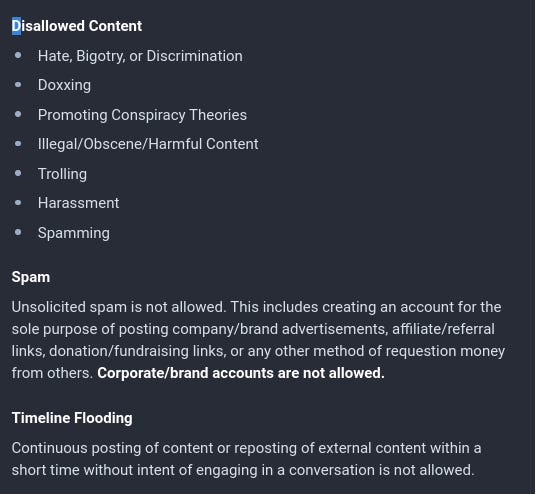
One of the things I’ve heard about Mastodon is that people who don’t abide by an instance’s rules get kicked off FAST. One of the things we’ve just gotten used to with commercial social media is that it will take weeks or months—if ever—to have someone awful removed from them. Instead, on Mastodon, it seems to generally only take hours. That’s a function of the size of instances. But it’s also a function of the fediverse.
If someone doesn’t like the rules on a particular instance, they can go find another. The people who set up an instance get to set the rules, and if anyone joins the assumption is that they agree to abide by them. This gives the people who volunteer to moderate total and ultimate authority.
Not only do the moderators get to choose who can be in the local instance, they also get to choose which other instances they will connect with over the fediverse. If they choose to cut another instance off, it is totally isolated from it. Just to illustrate this point, here’s a sample of just some of the other instances that Mindly. social has banned.
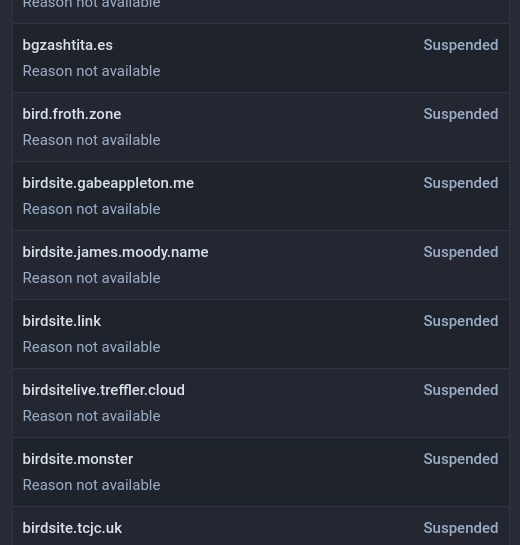
I went through and used my web browser to look at these sites. Some of them are just gone. Some are adverts for businesses. Some seem to be clones of 4Chan—complete with juvenile jokes, pornographic maga images, anti-Muslim, gay, etc ‘jokes’, pro-Russian propaganda, and, references to Fascist and NAZI notions. None of them were anything I wanted to have anything to do with. At this time there are something like 300 banned instances. What this means to me is that there are a lot of ‘bad actors’ out there who want to make money, recruit vulnerable people, or, just sabotage Mastodon so it doesn’t work—but the basic structure of the fediverse and the software allows moderators to keep them away.
This illustrates a key principle of Mastodon. It was designed by programmers to specifically be the social media system that was designed to not have all the problems that all the others are prone to. And from what I’ve seen from a couple months of use, Mastodon works very much as it was intended.
The point about Mastodon isn’t that it censors what people can say or talk about among themselves. Instead, it’s about ordinary people having the right to exclude this nasty crap from their personal conversations. And that’s the thing about for-profit social media that really bugs me. It has become innundated with stuff that I don’t want to watch, stuff that I find at best a waste of my time, and, at worst things that deeply irritate me. For profit systems like FaceBook say that there is a way to complain about nasty or dumb stuff, but it never seems to work when I try to use the controls. (If it did Donald Trump would never have been allowed on either Twitter or Facebook.) In Mastodon the system works almost instantly.
There is, of course, a negative side to this. There are instances filled with NAZIS and other types of hate-filled people. But Mastodon isolates these jerks from any who doesn’t want to listen to this nonsense and just want to do some good in the world. Left on their own without having to deal with unnecessary aggravation, it is a lot easier to learn, organize, and, build healthier communities.
Moreover, if anyone decides that they don’t want to be in the instance that they initially joined, they can easily switch to a new one. (I haven’t found a need to do this, as I have seen nothing wrong with Mindly.Social.) You can bring along your followers to the new instance, so nothing gets lost.
This article is heading on into War and Peace territory, so I’ll end it here. If you are interested, here’s a search engine you can use to find an instance to sign up with: https://mastodon.help/instances/en . And if you do sign up, here’s my handle: @CloudwalkingOwl@mindly.social. Connect if you want and we can follow each other in the fediverse.
I will check it out, thanks!
As someone who never really saw the appeal of microblogging and consequently never had a Twitter account, do you think I should join Mastodon too?