Rationing Your Mental Bandwidth
Learn to be aware of it--so you can direct it where it belongs

In Victor H. Mair’s translation of the Zhuangzi, there is a part of chapter 7 (Responses for Emperors and Kings) where he talks about something that happened to the sage Liezi when he was still a student of a Master Hu.
In the state of Cheng, there was a magus of the spirits named Chi Hsien. He knew all about people’s life and death, preservation and loss, misfortune and good fortune, longevity and mortality—predicting the year, month, week, and day as though he himself were a spirit. When the people of Cheng saw Chi Hsien coming, they would turn their backs on him and run away. But when Master Lieh went to see him, he was utterly intoxicated. Upon his return, he related his encounter to Master Hu: “I used to think of your way as the ultimate one, but now I have discovered that there is one still more ultimate.”
“What I have conveyed to you so far only deals with the surface,” said Master Hu. “We haven’t yet begun to deal with the substance. And you think you’re already in possession of the Way? If you only have a bunch of hens and no rooster, what sort of eggs are you going to end up with? You take your way and go jostling with the world, assuming that people will believe you, but that’s precisely why you let this fellow see through you. Try to bring him along with you next time and show me to him.”
The next day, Master Lieh came with the magus to see Master Hu. As they were going out, the magus said to Master Lieh, “Ay! Your master is dying! He doesn’t have much longer to live—less than ten days or so. I saw something strange about him. He looked like damp ashes.”
Master Lieh went back in. His lapels soaked with tears and snivel, he related to Master Hu what the magus had said.
“Just now,” said Master Hu, “I showed myself to him in the patterns of the earth. Unconscious, I was absolutely motionless. He probably saw me with the wellsprings of my integrity stopped up. Try bringing him around again sometime.”
The next day, Master Lieh came again with the magus to see Master Hu. As they were going out, the magus said to Master Lieh, “Fortunately, your master met me. He has recovered and is fully alive. I have seen that his stoppage was only temporary.”
Master Lieh went back in and related to Master Hu what the magus had said. “Just now,” said Master Hu, “I showed myself to him in the appearance of heaven. I was affected neither by name nor by substance, and the wellsprings of my vitality issued from my heels. He probably saw me with my wellsprings in fine fettle. Try bringing him around again sometime.”
The next day, Master Lieh came again with the magus to see Master Hu. As they were going out, the magus said to Master Lieh, “Your master is unstable. There’s nothing I can do to read his features. Let’s wait till he stabilizes, then I’ll read his features again.”
Master Lieh went back in and related to Master Hu what the magus had said. “Just now,” said Master Hu, “I showed myself to him in the neutrality of Great Nonvictory. He probably saw me with the wellsprings of my vital breath in balance. The depths of the whale’s whirlpool are an abyss; the depths of blocked water are an abyss; the depths of flowing water are an abyss. There are nine types of abysses. Here I have shown three of them. Try bringing him around again sometime.”
The next day, Master Lieh came again with the magus to see Master Hu. Before the magus had even come to a standstill, he lost his composure and ran away. “Pursue him!” said Master Hu. Master Lieh pursued the magus, but couldn’t catch up with him. He returned and reported to Master Hu, “He’s disappeared; he’s lost. I couldn’t catch up with him.”
“Just now,” said Master Hu, “I showed myself to him with my ancestry having not yet begun to appear. I was emptily intertwined with it so that one could not discern who was who. Thus did I bend with the wind and flow with the waves. Therefore he fled.”
After this, Master Lieh came to believe that he had barely begun to learn. He returned home and did not go out for three years. He cooked for his wife and fed pigs as though he were feeding people. He took no sides in affairs and whittled himself back to the simplicity of the unhewn log. Clodlike, he stood alone in his physical form. Sealed off against perplexity, in this manner he remained whole to the end.
What was Master Hu doing that so strongly affected Chi Hsien? I can’t say with any sort of certainty.
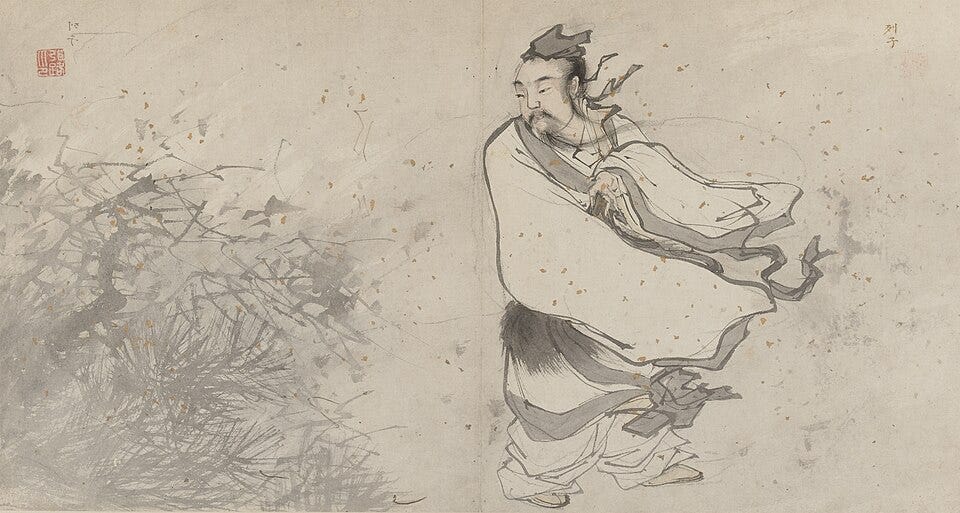
There are several reasons why I say this. First, it’s important to remember the above is not a passage from the Zhuangzi. Instead, it’s a translation of the Zhuangzi by Victor Mair. This isn’t to cast shade on Mair—he is a respected translator. But what I am trying to do is remind the reader that the process of translating any text—and especially an ancient one from a very different culture—involves someone making a lot of choices about what a specific passage means and how to express that meaning using a very different language for very different people in a very different culture.
I’m not saying that scholars should just throw their hands up and not bother trying to understand the original text. But I am saying ordinary folks need to remember that what they are doing is reading a modern text by Victor Mair that is based on an ancient text that was supposedly written by a Chinese sage with the name of Zhuangzi. This means that any type of Daoism I learn from it has a great deal that comes from the modern sage Victor Mair—as well as what originally came from Zhuangzi. And as someone who doesn’t know ancient Chinese and hasn’t spent my entire life learning how to translate it, I simply cannot tell where Zhuangzi ends and Victor Mair begins.
This doesn’t bother me because I see Mair as being not just a scholar of Daoism, but also as a member of the chain of Daoists who stretch back to the “Old Ones”. They created the oral tradition that eventually produced books like the Dao De Jing and the Nei Yeh—and all the other stuff that eventually became what we now call ‘Daoism’. Maybe Victor Mair, myself, and all the other people nowadays that write about the subject are the ‘young ones’ who are participating in creating a modern iteration of Daoism.
Beyond just remembering the difference between a text and its translation, I think it’s also important to remember that Daoist texts are often best understood as being ‘evocative’ instead of ‘descriptive’. That’s to say I believe that many of the works in the canon aren’t about trying to exhaustively describe a specific situation, process, or experience. Instead, they suggest to the reader that they should stop taking for granted our common assumptions about the world around us and look within for a deeper experience that lies behind them. This is the idea of making a distinction between the finger pointing at the moon, and moon itself.
In the case of the passage I cited above, we assume that each of us has some sort of discrete, individual, core to our being that is fundamentally the same from one moment to another and cannot be changed. I suppose what I’m saying is the idea that each of us has a ‘soul’. I’d suggest what the shaman Chi Hsein seems to be doing is looking into the soul of the people he meets. And when Chi meets Hu he finds someone who doesn’t seem to have an unchangeable, stable core to his being. Instead, he sees someone who appears to be able to change it at will and seems to be much more than a normal human being. This is so new to Chi it terrifies him, which leads to his running away like a scalded dog.
What does this say to a modern Canadian with a Western academic education—but who also has spent most of his life trying to understand Daoism?
The first few times I read the passage what stuck with me was the last bit.
After this, Master Lieh came to believe that he had barely begun to learn. He returned home and did not go out for three years. He cooked for his wife and fed pigs as though he were feeding people. He took no sides in affairs and whittled himself back to the simplicity of the unhewn log. Clodlike, he stood alone in his physical form. Sealed off against perplexity, in this manner he remained whole to the end.
What I got from this paragraph was there is something about living a mundane life that is important to understanding the Dao. Indeed, I used to take great satisfaction in the fact that a key text of Daoism talks of a sage who gained realization by helping his wife with her housework. How many world religions have a story like that?
But I’ve learned there is a huge gap between paying lip service to this point and actually living it. For years I liked this story—but I found myself too busy to actually do what it says. I was negligent about cooking for my wife. This caused friction in my household and even though I thought it would be a good thing theoretically—the execution failed to materialize.
I continued to think about it and then had a revelation. It wasn’t that I was lazy. It wasn’t because I couldn’t cook. It was because I didn’t want to use more than a tiny amount of my mental bandwidth to think about cooking.
Just as a computer is limited by the Random Accessible Memory (RAM) it uses to process data and run different subroutines, so too our minds have limits to what they can think about at any given moment. A great deal of how we think, moreover, involves non-conscious processing that is always happening in the background.
I’ve learned to recognize this happening through things like writing this blog. I do a lot of randomized reading that provides the foundation of a story. But just as important is a process where my subconscious runs in the background for days as it works out the key elements of the story. As a lived human experience I feel a sort of low-level, inarticulate obsession on the subject. If you wonder what I’m talking about, check out this scene from the movie Close Encounters of the Third Kind.
In the movie, the character portrayed by Richard Dreyfus has had a subconscious imperative implanted in his mind that is designed to push him to travel to Devil’s Tower in Wyoming where he will meet an alien ‘mother ship’. But the scene illustrates through exaggeration the experience of being obsessed about doing something. It also shows how intrinsically selfish these sorts of obsessions are. Roy’s wife and children see him playing with his food, which is ‘odd’. But far worse is the point that while he’s in the grip of this obsession, there’s very little room left for them in his mind. That’s why he apologizes to his children—his mental bandwidth is maxed-out by something else.
I understand this process intimately because I go through much the same thing when I write these articles (albeit without the mashed potatoes). The distance it creates between me and the other people in my life is very real. It’s not that I consciously ‘tune out’ them out. (Although I’ve often been accused of this by family and friends.) It’s that when my mind’s RAM is really busy processing something like the different ways we can define ‘efficiency’ or trying to make sense of what the phrase ‘holding onto the One’ means, I literally don’t hear what someone else is saying to me or don’t see what’s right in front of my face.
If someone doesn’t understand or care about the things I am trying to do in my life, this can be absolutely maddening. Even for someone who thinks what I’m doing is valuable, it can still be infuriating. That’s because it can quickly get out of control and make you a selfish person.
After a great deal of reflection it came to me that I didn’t mind doing my share cooking the meals for my wife and I—it is the time I have to spend thinking about it that I hate. Left to my own devices, I’d just buy a bag of Purina ‘bachelor chow’ and eat it three times a day. And that’s not what my partner had in mind.

It isn’t that I don’t know how to cook. In fact, at one time I was very good at it. I baked bread, made pies without a recipe, did all sorts of home canning, etc. But as time constraints multiplied in my life I lost all interest in cooking.
My significant other—who is tremendously supportive of my writing—puts a lot of thought into food. And while she is sympathetic, she made it very clear that she too has her own interests and doesn’t want to end up doing all the cooking. This nudged me towards introspection that led to me to thinking about this bandwidth issue. And that led me to that passage from the Zhuangzi where it specifically ties Liezi’s realization to the fact “he cooked for his wife” and “fed pigs as though he were feeding people”. In other words, Liezi took control and responsibility over what he both consciously and subconsciously became obsessed about. And once he did that, he decided to treat the ‘mundane’ parts of his life with the respect they deserved.
And that, in turn, led me back to the interactions between Master Hu and the shaman Chi Hsien. What was Master Hu doing? The short answer is—with regard to specific things like “stopping-up the wellsprings of his integrity”—I don’t know. But in the broader sense, I’d say that Master Hu had learned that he could consciously control how his mind worked in ways that a great many people never understand, or even think possible. Chi Hsien had never seen someone do this, and it totally freaked him out.
I had a friend who used to drive me crazy because he refused to even consider the idea that he had any ability to make even minor changes in his life. His stock answer was ‘I am who I am, and I’m not who I’m not’. If he forgot to do something, for example, he’d never consider the idea of creating a habit of putting things in a calendar—he’d just recite this stock phrase and I was supposed to leave it at that. I’m not about to say he should have done as I suggested and start using a calendar app on his phone. (A friend of mine pointed-out to me that this could be a mechanism he’d found in his youth that allowed him to set personal boundaries on his relationships with others. And that can be a very useful thing!) But I am going to suggest that who a person ‘is’ isn’t something set at birth that can never to changed a jot or tittle. If a person tries, they can change who they are—if not in total, at least in part.
Understanding this point, I realized that I was being selfish. First thing in the morning, I wanted to have breakfast in front of last night’s national news and not have to ask myself what I am going to cook for dinner. I also didn’t want to have to think about what I need to get from the grocery store in order to cook over the next week. I’d rather be fixating on writing articles for my blog. But the fact of the matter is I’m committed to having a relationship where my significant other is a partner—not the unpaid domestic help. This means I need to scale-back a bit of the time and energy I put into writing so I can have the mental bandwidth to cook more of the meals.
This is not a trivial issue. It says profound things about how our social and economic system is organized. There are a great many jobs in this world that expect people to put their heart and soul (or, their entire mental bandwidth) into their jobs. What this means is there has to be someone at home who gets stuck with not only the job of providing food, housework, and childcare, but also doing all the thinking about food, housework, and childcare.
What this means to me is there simply cannot be anything like equality between the sexes until society forces employers to allow all their people to not only have time off being at work doing things—but also the time to not be thinking about work, either consciously or unconsciously, for most of their lives. In other words, people need to not only have weekends, the 40 hr work week, and paid vacations. They also need the right to not be expected to be the best possible employees they can be. In other words, to have real work life balance—and equality between the sexes—we all need to fight for the right to be just ‘good enough’ while at work instead of ‘the best we can be’.
Perfectionism requires a tremendous amount of bandwidth, and mental bandwidth is the real currency of life. Even if someone only works four hours a day, if they need to spend the entire day thinking about what they do during those four hours—they are little more than slaves.
Recently my wife and I were watching a police series (Dark Winds—I strongly recommend it) where a woman leaves her Diné police chief husband who becomes distant after killing a criminal who committed manslaughter on their son as part of a business scam.
He did it because he realizes—as a police chief—that the killer is too wealthy and powerful to ever be convicted in the racist, settler courts of the American South West. Moreover, it isn’t just about his son. This fellow has killed other people from his tribe, and probably will kill more in the future. (There literally was nothing else the chief could do given the facts on the ground.) His wife understands all this. What she objects to is the way his position in the police has led him to devote too much of his mental bandwidth to his job—leaving her out of the picture.
The way she characterized this was by saying he was being ‘too selfish’. My significant other was very much on the side of the woman, whereas I couldn’t understand why anyone would use that particular word. After all, the police officer was trying to shield her from the FBI agents who were very concerned about the murder of a rich, important, white person. I thought that if anything, he was being selfless by trying to protect her. What I was missing was the insight from my contemplation of Liezi, Chi Hsien, and Master Hu. The husband was devoting all his bandwidth to his job—which froze-out his wife.
How often does something similar play-out in relationships all over our patriarchal world?
Nice one Bill, great story and great examples!